
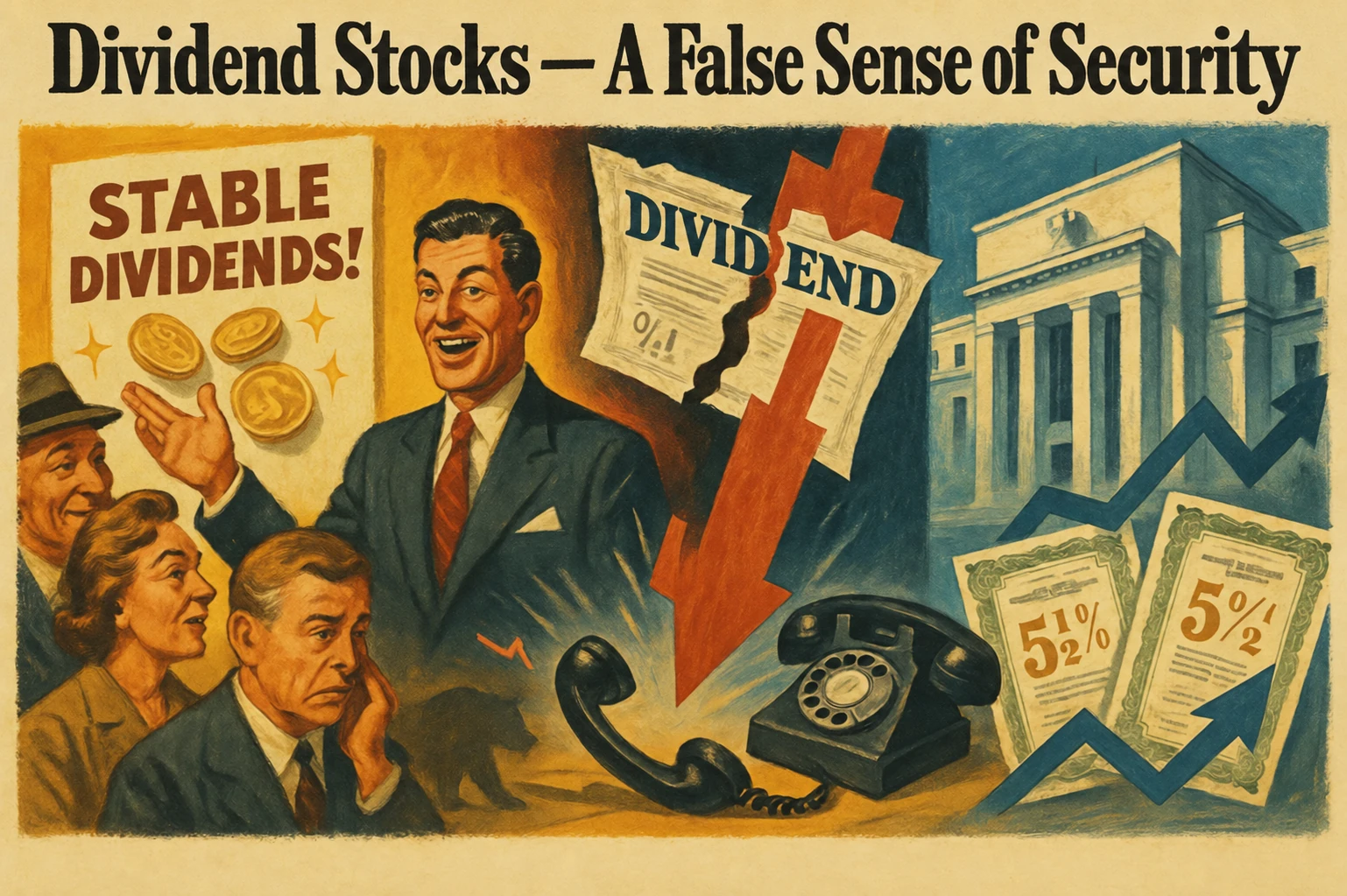
Stable companies, predictable cash flows and money that “drops in” regardless of the market mood. For many investors, dividend stocks seem like a rational choice in an uncertain world. Yet this picture conceals mathematical and psychological misunderstandings that can make a portfolio far more vulnerable than it appears. After almost sixteen years of largely uninterrupted market gains, a generation of investors has never experienced a genuine prolonged decline. Interest rates have returned, liquidity is tightening, and the security promised by dividends may prove to be an illusion. The real long-term winners are generally built through reinvestment, not distributions.
Dividends do not create value
Dividends are often presented as “free money” or proof of a company’s strength. In reality, a dividend merely redistributes the company’s own assets. If a company is worth 100 and pays out 5, its cash falls by 5 and the share price will normally be adjusted down by the same amount.
You do not own more after the dividend than before it; the money has simply moved from the company’s balance sheet to yours. Treating the payment itself as a source of value is therefore misleading. What matters is total return: the change in price plus distributions, less the risk taken to achieve it.
A distribution also removes capital that might have funded growth. Warren Buffett has long argued that the ideal company can retain its earnings and reinvest them at high rates of return over many years. For the shareholder, it does not matter whether value arrives through price appreciation or a dividend; what matters is whether the company continues to create value.
“The ideal business is one that can retain all its earnings and invest them at a high return for a long time.”
Amazon built its dominance without paying dividends, reinvesting in expansion instead. Alphabet followed a similar path by building YouTube, Android, Google Cloud and AI. Berkshire Hathaway has deliberately avoided dividends for decades and allowed capital to compound internally. In each case, reinvestment—not the cash distribution—did the work.
A company paying a steady 4–5 per cent dividend can still fall that much in a single day after bad news. In a bear market, declining profits can pressure both the share price and the dividend, erasing years of distributions in a matter of days.
The feeling of security
Dividend stocks are popular because they feel safe. A small payment every quarter creates an impression of stability, as if the company keeps delivering regardless of what the market does. The payment is tangible and easy to understand—but that is also why it can be dangerous.
The visible income becomes a mental safety signal even though the principal risk, the share price, remains. Price risk is usually many times larger than the annual distribution. A stock that falls 30 per cent is not rescued by a 4 per cent dividend. If the price then remains unchanged and the dividend is constant, recovering the lost capital takes roughly 9.4 years.
As the share price falls, the percentage yield rises for the wrong reason. The company has not become more generous; the market may be pricing in weaker profits, strained cash flow and a future cut. A conspicuously high yield can therefore signal weakness rather than strength.
High-yield stocks often run into trouble when the cycle turns. They may look steady in normal conditions, yet historically they have not reliably protected portfolios in crises. When equity markets fall sharply, dividend stocks can decline with the rest of the market.
Long cycles and reinvestment
Across long market cycles, growth companies can reinvest capital in their businesses at returns of 10–20 per cent or more. Every krona distributed is a krona that cannot be used for expansion, innovation or acquisitions, and the shareholder may also lose the compounding benefit on tax that is triggered by a payout.
A high dividend yield may look attractive beside a bank account, but in equities it often means that something is wrong. It can indicate a falling share price, weaker earnings, pressured cash flow, rising debt or an approaching dividend cut—the classic yield trap.
Borrowing to pay dividends
It sounds unreasonable for a company to borrow in order to maintain a dividend, but it happens. When cash flow is insufficient and management clings to a “stable dividend policy”, debt rises out of sight of investors focused on the payment.
AT&T financed parts of its dividend with new borrowing until the debt burden became unsustainable and the distribution was cut. General Electric did something similar during its decline. Shell and BP borrowed to support dividends during weak oil cycles and later reduced them sharply.
In Sweden, Castellum built its identity around continually rising dividends, then stopped the distribution entirely when higher interest rates exposed the strain. Cash flow could no longer carry the debt, credit conditions tightened, new equity diluted existing owners and the share price fell sharply.
When a company must borrow to fund a dividend, the payment is not evidence of strength. It is an early warning that the distribution may be unsustainable.
The myth of crisis protection
One of the market’s most persistent ideas is that dividend companies provide a safe harbour in a storm. History says otherwise. During the financial crisis, many classic high-yield stocks fell 50–70 per cent, while supposedly defensive companies cut their dividends as cash flows dried up.
General Electric fell by more than 80 per cent and drastically reduced its dividend. Bank of America and Citigroup collapsed in value and reduced payouts to symbolic levels. Pfizer, Ford and Wells Fargo also cut or suspended distributions.
When liquidity disappears and profits decline, the length of a company’s dividend tradition offers no guarantee. Capital leaving risky assets does not distinguish between a “dividend portfolio” and a “growth portfolio”.
Interest rates weaken the dividend case
The most dramatic change for dividend strategies came from the bond market. When interest rates are around 4–5 per cent, investors must ask why they should accept full equity risk for a 3–4 per cent dividend when government bonds, corporate bonds and short-duration fixed-income funds may offer comparable income with much lower volatility.
From 2010 to 2021, dividend shares benefited from rates near zero and investors searched everywhere for yield. Dividend income became a substitute for interest. Once rates normalise, that advantage diminishes.
Higher rates also increase companies’ financing costs and reduce the present value assigned to future profits. Capital can move towards bonds offering similar income with lower perceived risk. A strategy suited to a zero-rate environment can therefore become less attractive when interest once again earns a return.
The greatest danger
Charlie Munger put it bluntly: if you cannot tolerate seeing your investment fall by 50 per cent, you should not be in equities. Few people building a “safe” dividend portfolio imagine that its value can halve. Yet the attraction of these companies often begins with a desire for stability.
The greatest danger is psychological. When a share is down 60–80 per cent, few investors remain “long term”. Pain, sleepless nights and relentless bad news can drive a sale precisely when patience would matter most.
The dividend cannot stop the panic or protect the portfolio. It is paid while the share price collapses—like receiving a glass of water while the house is burning. Some companies never recover; others go to zero.
Security is an illusion
Dividend stocks are not inherently dangerous. The danger lies in the confidence they project. They create the feeling that money is working regardless of the market, while the actual risks remain in the share price, the business cycle, profitability and leverage.
In a world of higher rates and volatility, emotional security must be separated from financial security. Dividends may provide the former, never a guarantee of the latter.
In practice, investors may be choosing businesses that distribute earnings because they lack sufficiently profitable opportunities to reinvest them. The strongest long-term stock-market gains are not created where profits are paid out, but where they can be reinvested productively.
Henrik Hallenborg
This article may be shared, quoted and republished provided Henrik Hallenborg is credited as the author and a link to the original is included. Read the terms →